How to Stop School Shootings
Have we been going about this all wrong?


For the last fifteen years or so, school administrators have expended countless hours and untold tax-payer dollars on anti-bullying programs and social emotional learning. My reaction was and is mixed. A positive school culture— like a positive work culture — matters. As a parent of a child who was at one time relentlessly bullied, I saw that learning cannot happen unless a child feels safe. And surely, adults using and reinforcing an emotional vocabulary to young people is always a good thing. (Try to use your words. Do you feel angry or frustrated?)
As a journalist and author, I also observed some first class nonsense being foisted on to school children in the name of social-emotional learning. It also made me uneasy to see that these programs sometimes seemed to be providing moral education to public school children without explicitly saying as much. That seems like an overstep and one that raised red flags for me. Parents, not school administrators acting on behalf of the state, should get to decide who imparts a moral education to their children — and how. Some parents do this explicitly by sending their kids to parochial school. Some provide a moral education for their children around the dining room table. Or at Boy Scouts. Or at a No Kings protest. Another criticism: those programs eat up instructional time without any clear goals or evidence that they reach those goals. Teachers have an important job - teaching. They are not trained mental health professionals and should not be expected to act as such.
The reason schools are obsessed with anti-bullying programs is because we are all quite rightly horrified by school shootings. Even listing the high profile ones here is unbearable and brings tears to my eyes. And in the last two decades, prevention became a huge national mandate. So I read with interest the column written by my friend Jill Barshay in the Hechinger Report (nonprofit education journalism. Check it out.) She highlights something exceedingly rare: an influential academic who has changed his mind and is happy to talk about it. In this case, Ron Avi Astor, one of the nation’s leading experts on school violence and a professor at the University of California, Los Angeles. He has now concluded he was wrong: anti-bullying and social emotion learning programs, while well meaning, did nothing to reduce school shootings.
Here’s an excerpt from Jill’s excellent column:
“For decades, Astor believed that improving school climate and reducing bullying would help prevent school shootings. He advised national policymakers and issued recommendations. Schools responded by investing heavily in social-emotional learning, restorative justice, trauma-informed care, counseling and other efforts to make schools safer and more welcoming. Those initiatives have benefited students in many ways. Fewer students report bringing guns or knives to school, and schools have generally become safer. But school shootings have not declined.”
Here are the graphics Astor showed to a conference of education researchers in the spring.
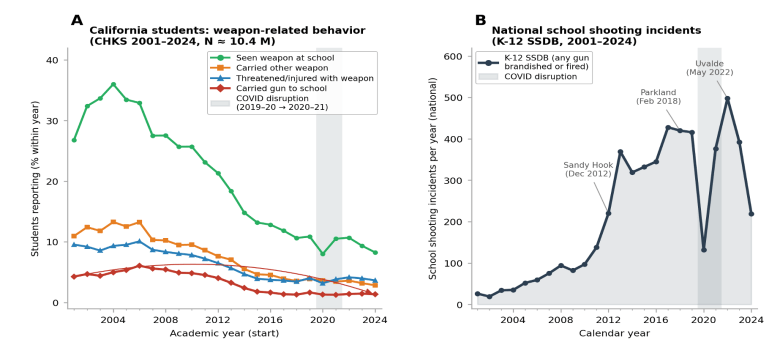
Instead, Astor is pointing to school shootings as an act of media-centric suicide. And suggests that if we stop making headlines about the shooters, the impulse will fade. (It can be hard to see, but acts of violence follow certain trends. For example: during the 1970s, plane hijackings were a regular thing and garnered massive headlines. Now, not so much.)
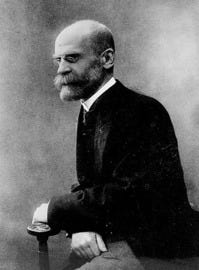
Which brings up many questions for me, most are more complicated than you probably want to read about right now. I will conclude by commending this essay about the writing of French sociologist Emile Durkheim in First Things. (First Things is a journal of religion and public life that I dip into. Skews conservative and usually not looney.) The essay on Durkheim is 100% worth your time, if you’ve got it. In brief, it encourages us to see suicide (whose rates are stable within particular societies) as an artifact of our society, not as an act of an individual. It is, he posited, a byproduct of the collective. The essay explicates Durkheim’s three root societal causes. Reduce school shootings by looking at those causes.
And one more note. The downstream effects of the policies that Astor has championed during his career have not been entirely benign. It placed responsibility on schools that more appropriately rests with all of us. (Sounds familiar.) We are also learning that when adults force themselves into the social dynamics of children, which often happens under the guise of “anti-bullying,” something is lost. Young people lose the ability to figure things out for themselves. And that destroys their agency, the very thing they need to thrive in the world.